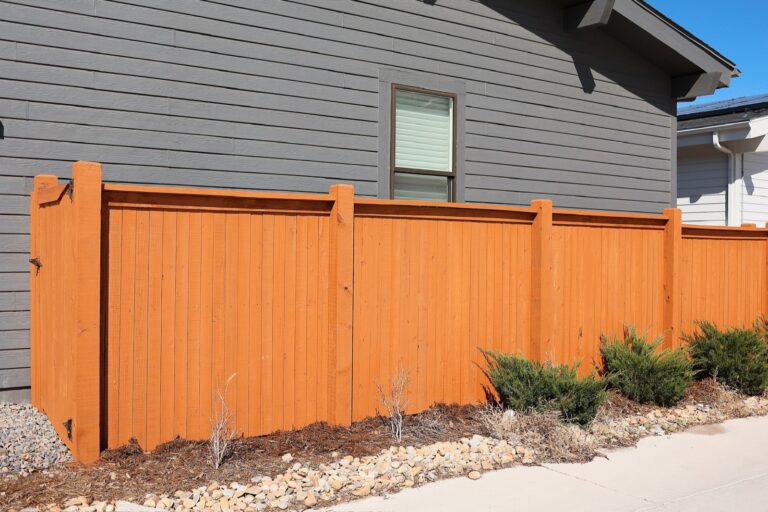
A professional fence build follows a strict order: mark the utilities, lay out the line, dig post holes below the trouble zone, set the posts in concrete and let them cure, hang the rails, fasten the pickets, build the gates last, and protect the whole thing with stain. Skip a step or rush one, and the fence tells on you within a few winters. This is the sequence our crew runs on every build across Colorado and greater Austin, illustrated with real photos from Golden Stain jobs.
Step 1: Layout and utility locates
Before anyone touches a shovel, we call 811 so the utility companies can mark buried gas, electric, water, and communication lines. The locates are free, required in most places, and non-negotiable on our jobs. An auger does not care what it hits.
While the locate flags go in, we confirm the fence line itself:
- Property lines. We work from your survey pins or plat, not from where the old fence happened to sit. Old fences drift.
- String lines. A tight string from corner to corner keeps every post on the same plane. A fence that wanders even an inch reads as crooked from the street.
- Grade changes. On sloped yards we decide up front whether the fence steps down in level sections or racks to follow the ground, since that choice affects post spacing and panel style.
Step 2: Digging the post holes
Post holes are where fence quality is decided, and it happens underground where nobody ever sees it. On smaller jobs a two-person gas auger or hand digging gets it done. On bigger runs we bring a hydraulic auger, which drills clean, consistent holes all day without wearing out the crew or the schedule.

Consistency matters more than speed here. Holes that vary in depth mean posts that settle at different rates, and that shows up later as a wavy top line. Rocky Colorado soil and the hard caliche pockets around Austin both fight the digging, which is another reason hydraulic power earns its place.
Step 3: Post depth and concrete
The rule of thumb in the trade is that roughly a third of the post lives underground. For a typical six foot privacy fence, that means holes in the range of two feet or more, and in Colorado the hole needs to reach below the local frost line so freeze-thaw cycles cannot heave the post upward.
How the post gets set matters as much as how deep:
- Gravel at the base gives water somewhere to go instead of pooling under the post.
- Concrete around the post locks it in place against wind load and gate swing.
- A crowned top on the concrete, sloped away from the wood, sheds rain instead of holding it against the post like a cup.
- Cure time before loading. Rails and pickets wait until the concrete has set, because loading a green footing shifts the post.
Why fence posts fail at the ground line
Walk down any alley and look at leaning fences. Almost none of them failed at the top. They failed at grade, right where the post exits the concrete or the soil. That narrow band gets the worst of everything: rain splash, snow sitting for weeks, sprinkler spray, soil moisture wicking upward, and sun baking it dry in between. Rot moves in at exactly that line, and once the post is soft there, the whole panel hinges on it in the wind.

A professional build defends that ground line from day one: pressure-treated posts rated for ground contact, footings that shed water instead of trapping it, and a finish that slows moisture swings in the wood above grade. None of it makes a post immortal. All of it buys years.
Step 4: Rails and pickets
With posts cured and dead straight, the skeleton goes on. Horizontal rails, usually two or three per section depending on fence height, tie the posts together and carry the pickets. We fasten rails with exterior-rated screws or ring shank nails, because smooth fasteners back out as the wood moves through the seasons.

Vertical picket fences
The classic. Pickets hang from the rails, tops cut to a consistent line, gaps set by spacer so they stay even across the whole run. Vertical styles rack well on slopes and are the workhorse of Colorado backyards. They earn their keep on sloped lots around Castle Pines, where almost nothing is flat.
Horizontal styles
Horizontal fences flip the logic: the boards themselves run parallel to the ground, so every board acts like a rail. That look is clean and modern, and it is everywhere in newer Austin and Denver neighborhoods. It also demands more from the build. Posts must be closer together to keep long boards from sagging, and board quality matters because a cupped board has nowhere to hide in a horizontal wall.

Step 5: Gates, the part everyone touches
A fence gets looked at. A gate gets used, hundreds of times a year, and it is the first thing to sag on a cheap build. We treat gates as their own small project:
- Beefier hinge posts. The post carrying the gate takes constant swinging load, so it gets extra attention on depth and concrete.
- A square, braced frame. Diagonal bracing or an anti-sag kit keeps the gate from slowly turning into a parallelogram.
- Hardware rated for outdoors. Hinges and latches sized for the gate weight, not whatever was cheapest on the shelf.
Step 6: Finished with stain, from day one
Golden Stain started on the fence line, stripping gray, tired wood and brushing life back into it. So when we build a fence, we build it the way a staining crew would: with the finish in mind from the first board. Sun in Colorado and heat in Texas start working on bare wood immediately, so a new fence should not stand naked for years while it fades to gray. That is the first thing we tell homeowners putting in new fencing in Bee Cave and the rest of the Hill Country.
When we stain your new fence, the work comes with our written warranty, presented before the job starts: 1 year on transparent stain, 2 years on semi-transparent, and 3 years on solid stain. The finish is the step most fence companies treat as an afterthought. For us it is the family business.
Frequently asked questions
How deep should fence posts be set?
The common rule is about one third of the post underground, so a six foot fence usually calls for holes around two feet deep or more. In Colorado the hole should also reach below the local frost line so freeze-thaw cycles cannot push the post up over time.
Why do fence posts rot at the ground line?
Because that narrow band at grade stays wet the longest and cycles between soaked and baked more than any other part of the fence. Water splashes there, snow sits there, sprinklers hit it, and soil moisture wicks into it. Ground-contact-rated posts, footings that shed water, and a maintained finish all slow that process down.
Is a horizontal fence harder to build than a vertical one?
It is less forgiving. Horizontal fences need tighter post spacing so the long boards do not sag, and they need straighter, better quality boards because every flaw shows. Built correctly, they hold up just as well and look sharp for years.
Should a new fence be stained right away?
A new fence should not go unprotected for years, because UV starts graying bare wood almost immediately. The right window depends on the wood and its moisture content, and we check that on site. When we handle the finish, it comes with a written warranty on the stain work.
Get your free estimate
Thinking about a new fence in Colorado or the Austin area, or wondering whether your current one can be saved? Call or text Golden Stain at 720-233-5487 and we will walk the line with you. Free on-site estimate. No pressure, no obligation, ever. One team, one number, one standard of care.
Explore more
Ready for the real thing? Browse all our services, the areas we serve across Colorado and Austin, and our home-care journal, then call 720-233-5487 for a free estimate.